Renin is a critical enzyme in the renin-angiotensin-aldosterone system (RAAS), a hormone system that regulates blood pressure, fluid balance, and electrolyte homeostasis in the body. By measuring renin levels in human samples such as plasma and serum, the Human Renin ELISA provides crucial insights into the function of this system. This assay is a powerful diagnostic and research tool for understanding hypertension, cardiovascular diseases, and kidney disorders—conditions often associated with abnormal RAAS function.
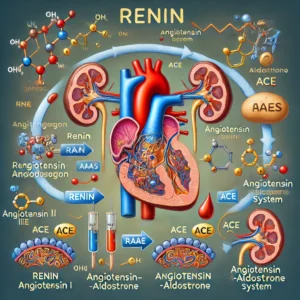
The Renin-Angiotensin-Aldosterone System (RAAS) and Its Role in Disease
Renin, produced by the juxtaglomerular cells of the kidney, catalyzes the conversion of angiotensinogen, produced by the liver, into angiotensin I. Angiotensin I is then converted into angiotensin II by angiotensin-converting enzyme (ACE), primarily in the lungs. Angiotensin II is a potent vasoconstrictor that increases blood pressure and stimulates the secretion of aldosterone, which leads to sodium and water retention. Dysregulation of this pathway can lead to a variety of health issues, most notably hypertension and cardiovascular diseases.
For more in-depth information about RAAS, check out the National Institutes of Health (NIH) and the Centers for Disease Control and Prevention (CDC).
Clinical and Research Applications of Human Renin ELISA
- Hypertension Diagnosis and Management:
Renin is a key biomarker in the diagnosis and management of primary and secondary hypertension. Primary hypertension often involves low renin levels, while conditions like renovascular hypertension are characterized by elevated renin levels due to impaired blood flow to the kidneys. The Human Renin ELISA helps clinicians identify the type of hypertension and tailor treatments accordingly. For further reading on hypertension, visit the CDC’s Hypertension Guidelines and American Heart Association (AHA). - Cardiovascular Disease:
Abnormal renin production and RAAS dysfunction are closely associated with cardiovascular diseases such as heart failure, atherosclerosis, and myocardial infarction. By measuring renin levels, the ELISA assay assists in understanding how RAAS dysregulation contributes to these conditions, aiding in the development of therapies targeting RAAS. Researchers focusing on cardiovascular health can explore more at the National Heart, Lung, and Blood Institute (NHLBI) and NIH. - Kidney Disorders and Renin:
The kidneys are directly involved in renin production, and disorders like renovascular hypertension, chronic kidney disease (CKD), and diabetic nephropathy often involve changes in renin levels. Renin ELISA is an essential diagnostic tool for nephrologists investigating kidney function and its relationship with systemic blood pressure. You can explore kidney health and RAAS-related kidney disorders at the National Kidney Foundation (NKF) and NIH’s National Institute of Diabetes and Digestive and Kidney Diseases (NIDDK). - Endocrine Disorders and Renin-Aldosterone Ratio (RAR):
In conditions such as primary aldosteronism (also known as Conn’s syndrome), aldosterone production is elevated, while renin levels are low. This imbalance leads to hypertension, hypokalemia (low potassium), and other complications. Measuring the renin-aldosterone ratio (RAR) using the Human Renin ELISA and an aldosterone assay is crucial for diagnosing aldosterone-driven hypertension. The ratio provides essential information for determining the underlying cause of high blood pressure. More about endocrine disorders and the renin-aldosterone ratio can be found at the Endocrine Society and NIDDK.
How the Human Renin ELISA Works
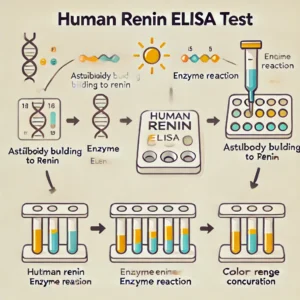
The Human Renin ELISA operates on the sandwich ELISA principle. In this assay, specific antibodies immobilized on a microplate capture renin from biological samples like serum or plasma. A second antibody, which is enzyme-conjugated (commonly with horseradish peroxidase or HRP), binds to a different epitope on the renin protein. The enzyme’s interaction with a substrate produces a measurable color change that is directly proportional to the amount of renin present in the sample. This method allows for the precise quantification of renin levels.
For more on ELISA protocols and principles, visit the CDC’s Laboratory Science and Safety and NIH’s Assay Development Resources.
Advantages of Human Renin ELISA
- Highly Sensitive and Specific:
The Human Renin ELISA kit provides high sensitivity, enabling the detection of even very low concentrations of renin in serum and plasma. Its high specificity ensures that the assay only detects renin, with minimal cross-reactivity with other proteins, making it suitable for accurate diagnostic and research applications. Further details on assay sensitivity can be found at the National Institute of Standards and Technology (NIST) and FDA’s ELISA Guidelines. - Reproducible and Quantitative:
The Human Renin ELISA is known for its reproducibility, providing consistent results across multiple experiments. Its quantitative nature allows for precise measurement of renin levels in both physiological and pathological conditions. Reproducibility and accuracy are essential for clinical diagnostics and research studies, and you can find more on this topic at NIH. - User-Friendly Protocol and Cost-Effectiveness:
The assay features a streamlined, easy-to-use protocol, making it accessible for both routine diagnostics and large-scale research. Its affordability and robustness make it an attractive choice for clinical laboratories and research institutions. For more on user-friendly and cost-effective assays, check out NIH’s Research Resources.
Emerging Applications of Human Renin ELISA
Recent research has highlighted additional applications for renin measurements, particularly in understanding the role of the renin-angiotensin system in inflammation and COVID-19. Since angiotensin-converting enzyme 2 (ACE2) is involved in SARS-CoV-2 entry into cells, the interplay between renin, ACE, and ACE2 has drawn significant attention in studying the inflammatory responses in COVID-19. The Renin ELISA could play an emerging role in these novel research areas, as more scientists explore how RAAS components are involved in infectious diseases.
For more on COVID-19 and its relationship with the RAAS system, explore research at NIH’s COVID-19 Research and CDC’s COVID-19 Hub.
Conclusion
The Human Renin ELISA is a vital assay for researchers and clinicians focused on the renin-angiotensin-aldosterone system. Its applications span hypertension research, cardiovascular disease management, kidney function analysis, and endocrine disorders. The assay’s accuracy, reproducibility, and ease of use make it an invaluable tool in understanding the complexities of RAAS and its influence on health and disease. As research advances, the Human Renin ELISA will continue to contribute to breakthroughs in both clinical diagnostics and academic research.
For further information on renin, the renin-angiotensin system, and RAAS-related research, explore resources from NIH, CDC, and American Heart Association.
References and Educational Links
Here are additional resources cited throughout the article:
- National Institutes of Health (NIH)
- Centers for Disease Control and Prevention (CDC)
- National Institute of Standards and Technology (NIST)
- National Heart, Lung, and Blood Institute (NHLBI)
- National Kidney Foundation (NKF)
- National Institute of Diabetes and Digestive and Kidney Diseases (NIDDK)
- American Heart Association (AHA)
- Endocrine Society
- National Center for Biotechnology Information (NCBI)
- Food and Drug Administration (FDA)
- PubMed